When the Rest of the City Sleeps: The All-Night Businesses Holding Neighborhoods Together
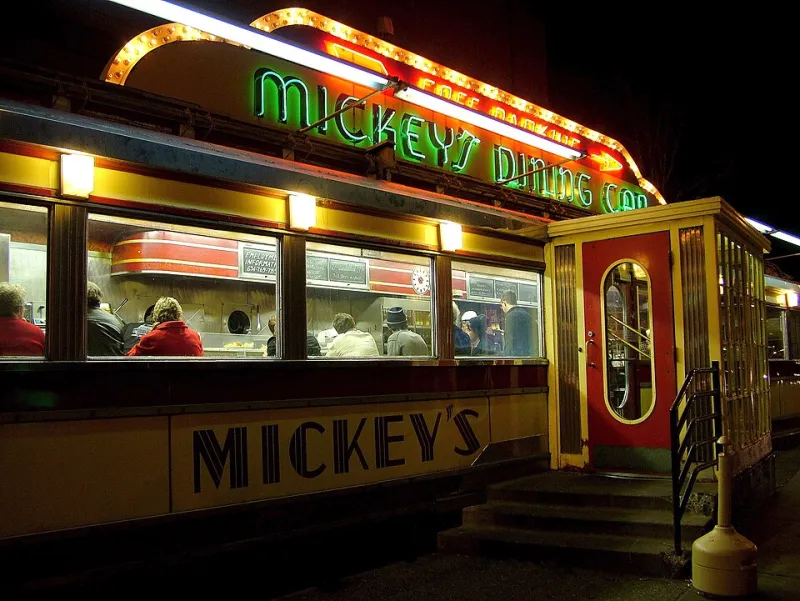
Photo: kkmarais, CC BY 2.0, via Wikimedia Commons
Somewhere around 2:30 in the morning, a city reveals its truest self. The performative bustle of rush hour is long gone. The dinner crowd has cleared out. What's left is something quieter and, honestly, a lot more interesting — a loose network of fluorescent-lit establishments that never pull the shades down, populated by a rotating cast of characters who've quietly formed one of the most overlooked communities in American urban life.
We're talking about the all-night diner where the overnight nurses grab pie before their shift ends. The 24-hour gym where a retired postal worker and a college student spot each other on the bench press at 4 a.m. The coin laundromat where, on any given Tuesday night, you might find a cab driver, a new mom, and a line cook all folding clothes in companionable silence — or sometimes not silence at all.
These businesses don't make the "best of" lists. They rarely go viral. But ask anyone who's ever worked nights, dealt with insomnia, or just lived a schedule that doesn't fit the 9-to-5 mold, and they'll tell you: these places are everything.
A Different Kind of Third Place
Urban sociologists have long talked about the concept of the "third place" — the community space that exists beyond home and work. Think barbershops, coffee shops, parks. But that framework has always assumed a daytime world. What happens when your third place has to exist at midnight?
For millions of Americans — night-shift nurses, warehouse workers, security guards, bartenders clocking out after last call — the standard community infrastructure simply isn't available when they need it. The library closes at 8. The farmers market is on Saturday morning. The neighborhood block party? Good luck if you slept through it because you worked until 6 a.m.
That's where the 24-hour economy quietly steps in and does something remarkable. It creates community on a parallel track.
Take the classic American diner. There's a reason the all-night diner has been a cultural touchstone from Edward Hopper's Nighthawks to every road trip movie ever made. It's not just the coffee. It's the fact that at 3 a.m., the usual social hierarchies dissolve a little. The guy in scrubs and the guy in a delivery uniform are both just people who need eggs and a place to sit for a minute. Regulars develop. Inside jokes accumulate. Staff remember your order.
"I've been coming here after my shift at the hospital for six years," said one ER nurse at a 24-hour spot in her neighborhood. "Half the people I consider real friends, I met at that counter. You bond fast when you're all exhausted and it's 3 in the morning."
The Laundromat as Living Room
If diners are the social clubs of the overnight world, laundromats might be their more democratic cousin. There's a forced intimacy to a laundromat that no other business quite replicates. You're there for at least 45 minutes. You have nothing to do but wait. And you're surrounded by strangers doing the same deeply human, slightly vulnerable task of cleaning their clothes.
Late-night laundromats in particular attract a fascinating cross-section of people. Apartment dwellers whose machines are broken. Service industry workers who are only free after 11 p.m. Parents of young kids grabbing a quiet hour while a partner watches the baby. First-generation immigrants who've found the late hours less crowded and more comfortable.
Owners of these establishments often become accidental community anchors. Many stock Spanish-language magazines alongside English ones. Some keep a small shelf of kids' books. A few have quietly become the place where neighbors leave notes for each other, share information about local resources, or just catch up in a way that doesn't happen anywhere else on the block.
The 24-Hour Gym: Unlikely Equalizer
Fitness culture tends to be associated with a certain demographic — young, affluent, obsessed with peak hours and curated playlists. But step into a 24-hour gym at midnight on a Wednesday and you'll find something different. Older adults who find the empty gym less intimidating. Shift workers squeezing in a workout before heading home. People who simply couldn't afford the boutique studio and found that the big-box gym's overnight hours suit their lives just fine.
"The 2 a.m. crowd has its own vibe," said one longtime member of a national chain gym in his neighborhood. "People aren't there to be seen. They're just there. It's actually way more welcoming than the 6 p.m. rush."
Regular late-night gym-goers frequently describe forming genuine friendships — the kind built on consistent, low-pressure proximity over months and years. Which, when you think about it, is exactly how most lasting community bonds form.
What These Businesses Mean for Neighborhoods
Beyond the social dimension, 24-hour businesses carry real economic weight for the neighborhoods they anchor. They provide employment during hours when other options are scarce. They generate foot traffic that informally deters crime on blocks that would otherwise go dark. They pay rent and utilities that contribute to the financial health of commercial corridors.
And increasingly, urban planners and community advocates are starting to pay attention. Some cities have begun factoring overnight accessibility into neighborhood assessments, recognizing that a community that functions only during daylight hours is leaving a significant portion of its residents underserved.
There's also something to be said for what these places signal about a neighborhood's character. A block with a 24-hour spot on it is, in a very real sense, alive around the clock. It communicates that this is a place where people actually live and work at all hours — not just a neighborhood that performs vitality during the day and goes dark at night.
The People Who Make It Real
None of this happens without the workers. The overnight staff at these establishments are doing something that takes a particular kind of stamina and social skill — keeping things running and keeping things human at hours when most people are asleep.
They remember regulars' names. They notice when someone hasn't come in for a while. They diffuse the occasional tense situation with a calm word. In neighborhoods where formal community infrastructure can be thin, these workers are doing a kind of unofficial social work, and most of them would never describe it that way.
Next time you're up late and you find yourself pushing through the door of somewhere that's still open — really open, lights on, somebody there — take a second to notice what's around you. There's a community in there. It just runs on a different schedule than the one most people see.